If you are evaluating paper bag production equipment, one of the first and most important decisions is the level of automation. The choice between a fully automatic and a semi-automatic paper bag machine directly affects your production capacity, labor requirements, product quality consistency, and overall operating costs.
The short answer: fully automatic machines produce bags at 2–5× the speed of semi-automatic machines with significantly lower labor per bag, but they require a higher upfront investment. Semi-automatic machines have a lower entry cost and offer more flexibility for smaller volumes or frequent bag specification changes, but they demand more manual intervention and have higher per-unit labor costs.
This guide breaks down the differences in speed, cost structure, labor requirements, and decision factors to help you determine which type best fits your production needs.
What Is a Semi-Automatic Paper Bag Machine?
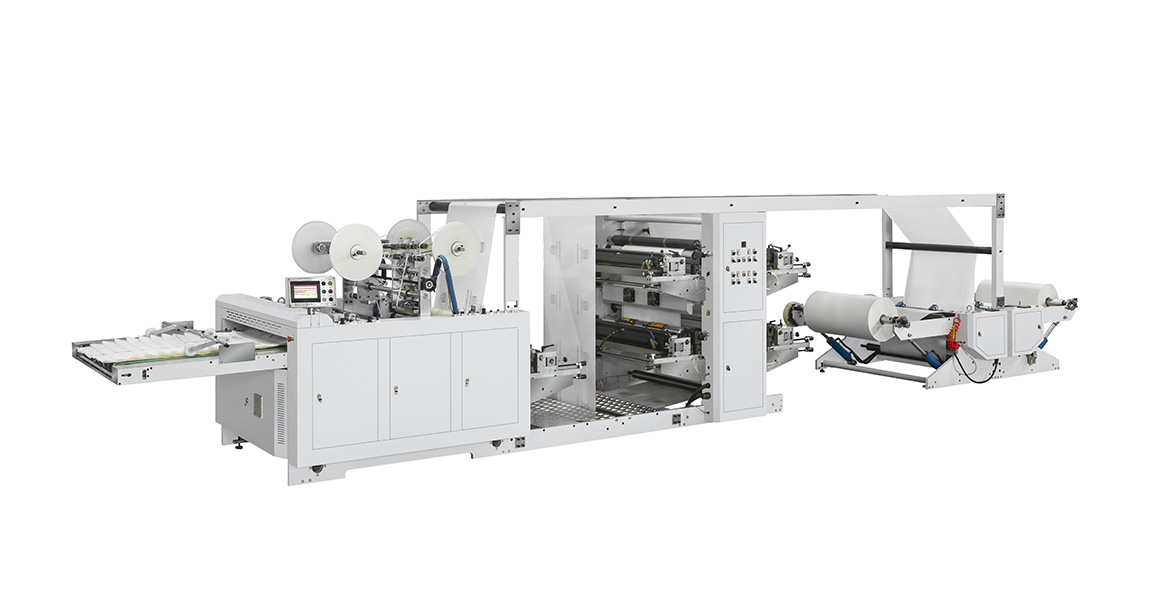
A semi-automatic paper bag machine automates certain stages of the bag-making process—typically bottom folding, gluing, and forming—but requires manual intervention for other steps such as feeding paper blanks or handles.
Key characteristics:
- Manual feeding: Operators place paper sheets or handle materials into the machine
- Modular process: Often divided into separate machines for different production stages
- Lower automation: Requires operator presence throughout production
- Flexible changeover: Easier to adjust for different bag sizes and styles
Semi-automatic machines are commonly used by small to medium-scale businesses, packaging workshops, and operations that produce a variety of bag types in smaller batches.
What Is a Fully Automatic Paper Bag Machine?
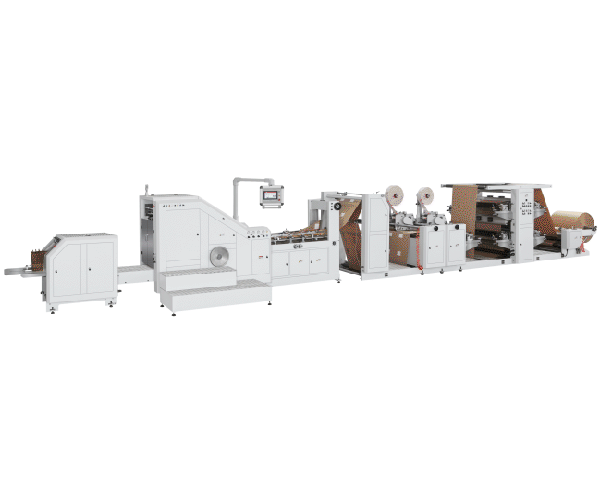
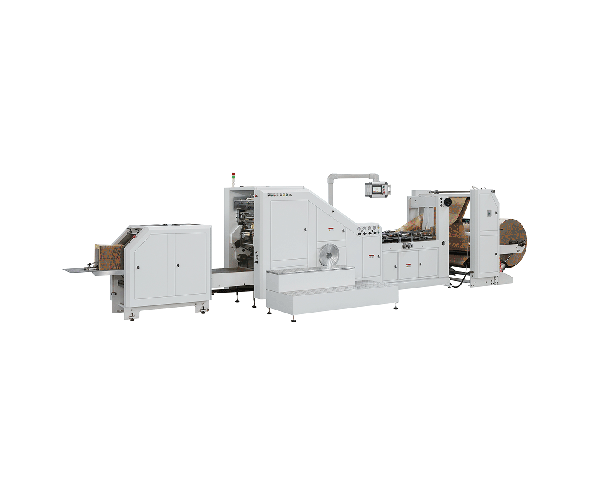
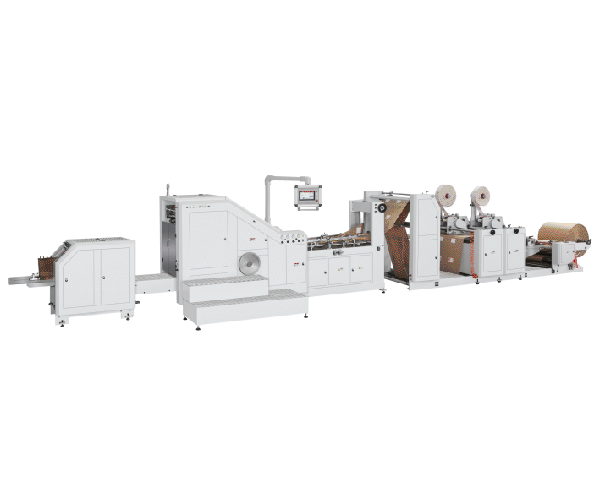
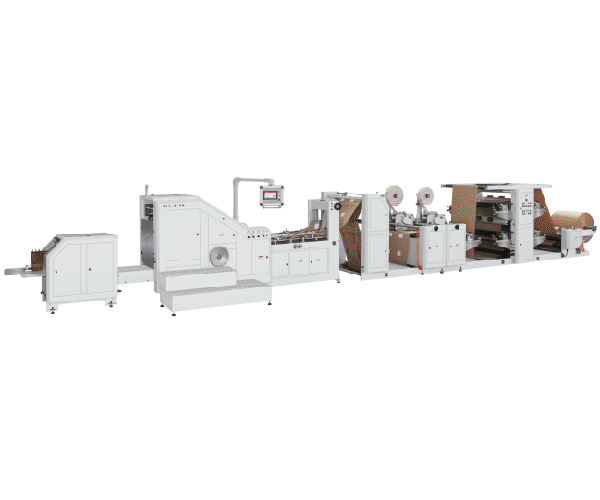
A fully automatic paper bag machine performs the entire production process from roll paper to finished bag in one continuous operation, with minimal manual intervention.
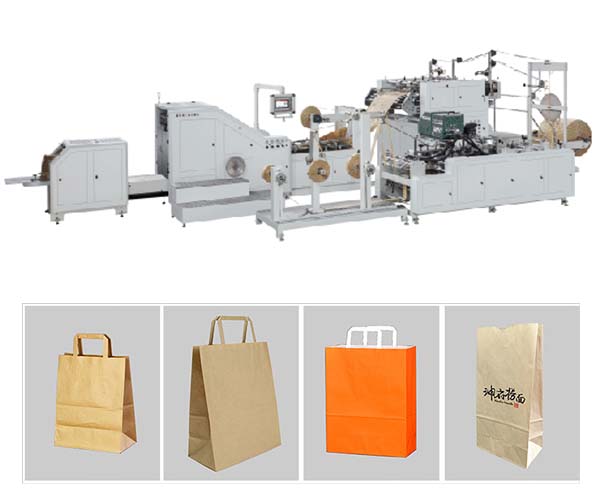
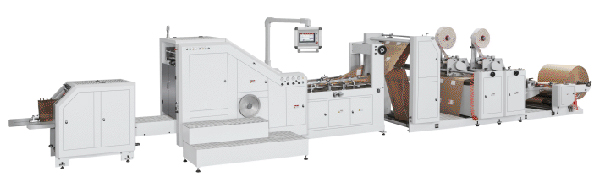
For example, the LSB-330D+TP fully automatic patch punching handle paper bag machine forms paper bags in a single process that includes: partial gluing, patch application, side gluing, roll folding, die-cutting handles, roll paper cutting, bottom folding, bottom gluing, and bottom forming. The machine is controlled by a PC-programmable servo motor through a human-machine touch screen interface.
Key characteristics:
- Roll-fed: Uses printed or unprinted roll paper as raw material
- One-pass production: All steps completed in a single continuous process
- Minimal labor: Operators monitor rather than actively participate in production
- High consistency: Automated processes reduce variation between bags
Fully automatic machines are ideal for high-volume, repeat-order production environments such as large packaging print factories, food service packaging suppliers, and retail packaging operations. Review the available fully automatic handle paper bag machine configurations to see the range of options.
Speed Comparison: How Fast Can Each Type Produce?
Production speed is often the most visible difference between the two machine types.
| Machine Type | Typical Speed Range | Production Per Hour (approximate) |
|---|---|---|
| Semi-Automatic | 50 – 125 bags/min | 3,000 – 7,500 bags |
| Fully Automatic | 150 – 300 bags/min | 9,000 – 18,000 bags |
For context, a fully automatic machine like the LSB-330D+TP has a maximum speed of 220 bags per minute under optimal conditions. However, actual production speed depends on multiple factors including paper quality, adhesive characteristics, bag dimensions, operator experience, and overall production workflow. Review the technical specifications for detailed parameter information.
The speed advantage of fully automatic machines becomes more pronounced at scale. A fully automatic machine can produce in one hour what a semi-automatic machine might take two to three hours to complete. For operations running multiple shifts or handling large contracts, this difference translates directly into revenue capacity.
Cost Structure: Upfront Investment vs. Operating Cost
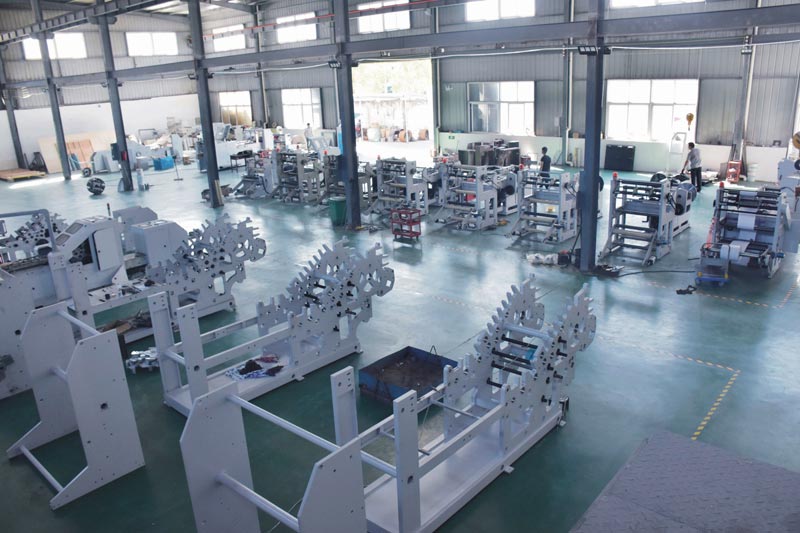
The cost difference between fully automatic and semi-automatic machines involves both initial capital expenditure and ongoing operating costs.
Upfront Investment
| Machine Type | Approximate Price Range |
|---|---|
| Semi-Automatic | $15,000 – $30,000 |
| Fully Automatic | $50,000 – $120,000+ |
Fully automatic machines typically cost 3 to 5 times more than semi-automatic models upfront. The price varies significantly based on features such as printing integration, handle application methods, speed capacity, and servo motor configuration.
Operating Costs
The cost-per-bag calculation tells a different story.
| Cost Factor | Semi-Automatic | Fully Automatic |
|---|---|---|
| Labor per 1,000 bags | Higher | Lower |
| Defect rate | Higher | Lower |
| Energy consumption | Lower per machine | Higher per machine, but lower per bag |
| Maintenance | Simpler, lower cost | More complex, requires specialized skills |
| Changeover time | Faster, more flexible | Slower, more involved |
Labor is often the largest ongoing cost difference. Semi-automatic machines require manual feeding and operator intervention throughout production. Fully automatic machines run with minimal supervision, allowing one operator to monitor multiple machines.
A frequently cited industry observation: fully automatic machines use approximately one-third the labor of semi-automatic setups for the same output volume. Over time, the labor savings from a fully automatic machine can offset the higher initial investment.
Decision Framework: Which Machine Fits Your Business?
The right choice depends on your specific production requirements, not just the machine specifications.
Choose a Semi-Automatic Machine If:
- Your production volume is modest — under 50,000 bags per month
- You produce a wide variety of bag sizes and styles — frequent changeovers are the norm
- Your budget is constrained — lower upfront cost is a priority
- You have access to reliable, lower-cost labor
- You are entering the market and want to validate demand before scaling
- Your orders are irregular — you cannot predict production volume month to month
Choose a Fully Automatic Machine If:
- Your production volume is high and consistent — repeat orders, large contracts
- Labor costs are high in your region — automation delivers clear savings
- You need consistent quality — automated processes reduce variation
- You run multiple shifts — machines can operate with minimal supervision
- You supply large retail chains, food service brands, or supermarkets — volume and consistency are non-negotiable
- You are planning for growth — the machine can scale with your business
A Note on "In-Between" Scenarios
Some manufacturers offer semi-automatic machines with higher levels of automation—for example, automatic bottom gluing with manual feeding. These "hybrid" options can be a practical middle ground for businesses that need some automation but cannot justify the full investment.
Common Misconceptions
"Fully automatic is always better." Not true. For small batches, frequent size changes, or operations with low-cost labor, a semi-automatic machine may offer better overall economics.
"Semi-automatic is cheaper in the long run." Not necessarily. While the upfront cost is lower, higher labor costs and defect rates can make semi-automatic machines more expensive per bag over time.
"Speed is the only thing that matters." Speed is important, but changeover time, maintenance requirements, and operator skill availability are equally critical decision factors.
Checklist: Evaluating Your Automation Needs
Before contacting suppliers, work through these questions:
- ☐ What is my current monthly production volume? What is the projected volume in 12–24 months?
- ☐ How many different bag sizes and styles do I produce? How often do I change over?
- ☐ What is my labor cost per hour? How many operators are available?
- ☐ What is my acceptable defect rate? How much rework can I tolerate?
- ☐ What is my capital budget? Can I finance a higher-cost machine?
- ☐ Do I have technicians who can maintain a fully automatic machine?
- ☐ Are my orders consistent or irregular?
- ☐ What quality standards do my customers require?
Frequently Asked Questions
1. Can a semi-automatic machine produce the same quality bags as a fully automatic machine?
Yes, in terms of final bag quality, both types can produce good results. However, fully automatic machines typically produce more consistent quality because they eliminate the variability introduced by manual operations. If your quality requirements are strict and your customers expect uniformity, automation provides an advantage.
2. How long does it take to recoup the higher cost of a fully automatic machine?
The payback period depends on your production volume, labor costs, and the price difference between the machines you are comparing. Higher volume and higher labor costs shorten the payback period. For operations with consistent high-volume orders, the labor savings alone can offset the cost difference within 12 to 24 months, but actual results vary by specific operating conditions. Buyers should calculate based on their own labor rates and production forecasts.
3. Can I start with a semi-automatic machine and upgrade later?
Yes, many businesses follow this path. Starting with a semi-automatic machine allows you to enter the market with lower risk and validate demand. When volume grows, you can add a fully automatic machine while keeping the semi-automatic unit for small batches, specialty bags, or as a backup.
4. Which type is easier to operate and maintain?
Semi-automatic machines are generally simpler to operate and maintain—they have fewer moving parts, less complex control systems, and require less specialized technical knowledge. Fully automatic machines require trained operators who understand servo motor control systems, touchscreen interfaces, and automated glue application systems. Consider your team's technical capabilities when making a decision.
5. Does a fully automatic machine handle different paper types and thicknesses?
Fully automatic machines can handle a range of paper types and thicknesses, but the specific range varies by model. For example, the LSB-330D+TP handles paper thickness from 60 to 170 gsm. However, changing paper types may require adjustments to tension control, glue application, and folding settings. Buyers should confirm paper specifications with the supplier.
6. What factors affect the actual production speed of a fully automatic machine?
Actual speed depends on paper quality, adhesive characteristics, bag dimensions, operator knowledge, and overall production workflow. The maximum speed listed on the specification sheet is achieved under optimal conditions. In real-world production, speed may be lower—especially when running heavier paper, complex bag designs, or when operators are still gaining experience.
Conclusion
Choosing between a fully automatic and a semi-automatic paper bag machine is not about which technology is "better"—it is about which technology fits your production volume, labor situation, budget, and growth plans.
Key takeaways:
- Semi-automatic offers lower upfront cost and greater flexibility for small batches and frequent changeovers, but higher labor costs per bag
- Fully automatic delivers higher speed, lower labor per bag, and more consistent quality, but requires a larger initial investment
- The right choice depends on your specific production volume, not on general recommendations
- Many businesses start semi-automatic and add fully automatic capacity as volume grows
- Always verify actual performance with your specific materials and production conditions
If your production volume is consistently high and you are planning for growth, reviewing the available fully automatic handle paper bag machine configurations is a logical next step. For businesses with lower volume or highly variable orders, a semi-automatic machine may be the more practical starting point.
Before making a final decision, request a production trial with your actual paper materials, confirm technical specifications with the supplier, and calculate your total cost of ownership—not just the purchase price.