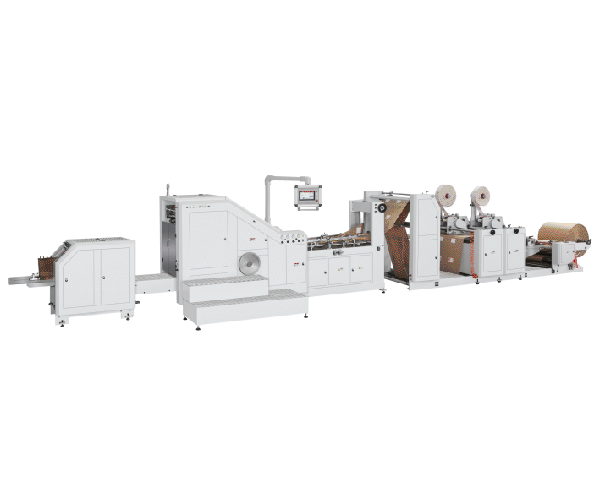
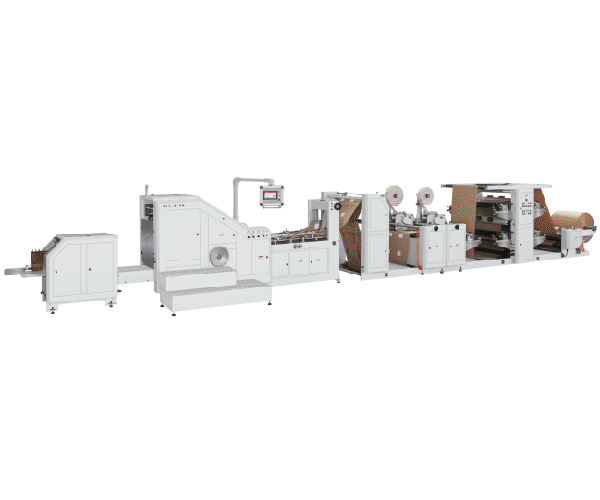
Your production manager is pushing for higher output. The sales team is promising shorter lead times. And you keep hearing that the machine should be able to run faster. So you increase the speed. Then the problems start—bags coming out misaligned, seals that don't hold, excessive waste piling up at the end of the line.
You are not alone. Many production facilities face the same dilemma: how to get more bags per minute without seeing quality plummet and scrap rates soar. Pushing a machine beyond its stable operating range often triggers a cascade of issues—mechanical vibration, tension instability, adhesive failures, and dimensional drift. One medium-sized paper bag factory invested in a high-speed machine only to see its pass rate drop from 98% to 92% within three months, wiping out the speed gains through downtime and rework.
This guide will walk you through the proven strategies to increase paper bag machine speed while maintaining—or even improving—product quality. You will learn what actually works, what doesn't, and how to make your speed upgrades sustainable.
The Real Cost of Chasing Speed Alone
Before discussing how to increase speed, it is worth understanding why simply turning up the dial is a recipe for disaster.
What happens when you push speed without preparation:
| Issue | Why It Happens | Real Consequence |
|---|---|---|
| Inconsistent bag dimensions | Paper tension fluctuates at higher speeds; mechanical inertia causes positioning errors | Bags that don't fit filling lines; customer rejection |
| Weak or uneven seals | Heat sealing time decreases as speed increases; temperature can't keep up | Bags bursting at the bottom; returns and complaints |
| Increased waste | Misalignment, misfeeds, and registration errors multiply at speed | 5–10% additional scrap; higher material cost per bag |
| Frequent jams | Paper feeding becomes unstable; sensors can't keep pace | Production stoppages; operator frustration |
| Accelerated wear | Higher loads on bearings, cams, and cutting blades | More frequent maintenance; shorter machine life |
High-speed operation demands higher technical skills from operators, and even minor errors can lead to continuous scrap. The key insight is that speed alone is not the answer—what matters is stable speed, maintained consistently over time, with quality controls that keep pace.
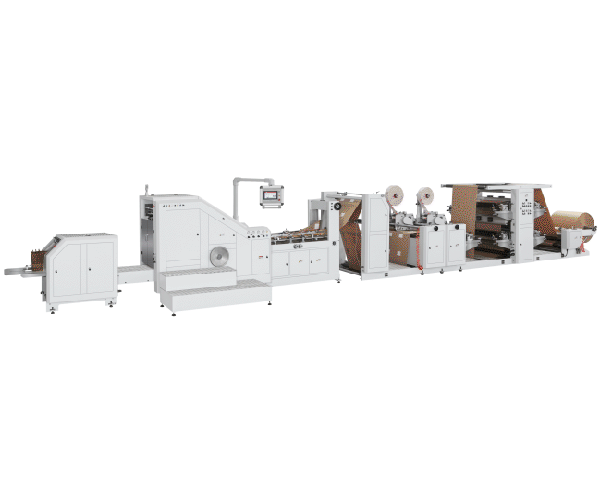
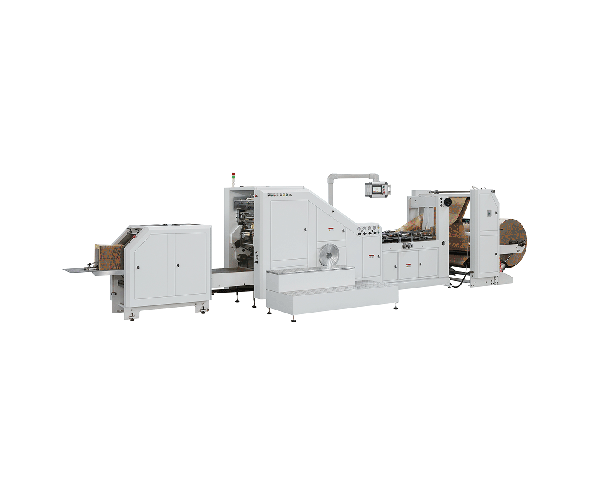
For machines designed with full-servo drive systems for stable high-speed operation, the speed ceiling is determined not by the motor's maximum RPM but by the control system's ability to maintain precision across all axes simultaneously.
Hardware Upgrades – What Actually Enables Higher Speed
If your machine is mechanically limited, no amount of parameter tweaking will push it faster. Here are the hardware upgrades that unlock true speed gains.
1. Full-Servo vs. Mechanical Drive
Traditional paper bag machines use a mechanical long-shaft transmission—a single motor driving everything through gears, cams, and clutches. This design has inherent speed limitations because synchronization accuracy between units is limited, making precise coordination difficult under high-speed operation.
Full-servo systems replace mechanical shafts with "virtual electronic axes." Each work unit is driven by independent servo motors, with a motion controller achieving millisecond-level synchronization through high-speed industrial Ethernet. This brings three advantages:
-
Simplified mechanical structure: Eliminates complex gearboxes, transmission shafts, and cam mechanisms—reducing mechanical inertia and maintenance difficulty
-
Improved dynamic response: Servo systems provide high dynamic response for faster cycle times
-
Precise synchronization: Each unit maintains strict synchronization during high-speed operation, with position errors controlled within ±0.1mm
One manufacturer reported that replacing mechanical drives with servo systems reduced feeding speed errors from ±0.5mm/s to ±0.1mm/s, increasing daily production by 18%.
2. Dual-Line Parallel Production
When single-line machines reach physical speed limits—where mechanical vibration and tension control problems increase exponentially—dual-line parallel technology offers a strategic way to break through capacity bottlenecks.
Instead of running one line faster, dual-line production splits the raw paper along the central axis into two equally wide strips, each undergoing independent gluing, forming, and cutting processes while sharing the same power source and control system. This spatial reuse effectively doubles output without pushing individual components beyond their stable operating ranges.
3. High-Performance Tension Control
Tension is the "lifeline" of paper bag machine operation. At higher speeds, tension fluctuations become more pronounced and more damaging. Modern systems use closed-loop control with floating rollers or ultrasonic tension sensors monitoring paper roll tension in real time, combined with servo motor torque compensation to keep fluctuations within ±2%. This prevents paper breakage or wrinkles even at elevated speeds.
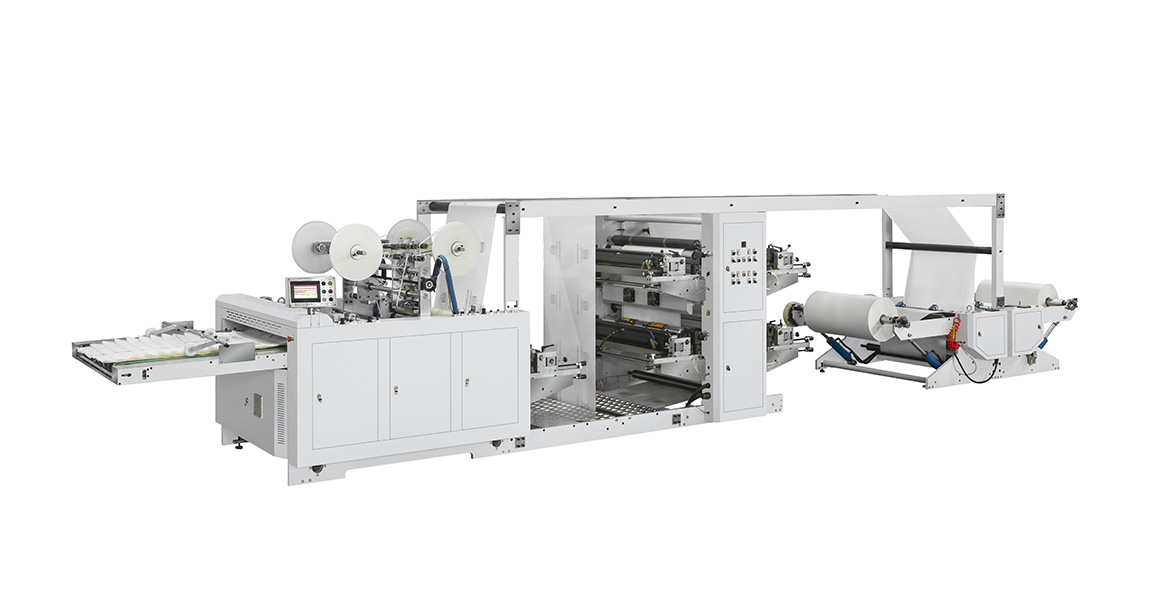
For lines that integrate inline flexo printing with bag making, tension control becomes even more critical—printing accuracy depends on consistent paper feed, and any speed-related tension drift shows up immediately as registration errors.
Software and Controls – The Brain Behind the Speed
Hardware provides the physical capability; software and controls determine whether that capability translates into consistent quality.
Electronic Shaft Technology
Electronic shaft (electronic gear) technology replaces physical mechanical axes with virtual ones controlled by software algorithms. Using a motion controller, each servo axis is coupled virtually, enabling precise coordination without the mechanical constraints of physical shafts.
For paper bag machines, this means:
-
Phase matching of paper feeding, forming, and bottom sealing stations is handled by electronic cam algorithms that dynamically compensate for cumulative errors caused by paper stretching—avoiding bag skew or loose sealing
-
Adaptive speed regulation automatically adjusts each unit's speed according to paper roll diameter changes and glue viscosity, reducing the frequency of manual intervention
Real-Time Quality Monitoring
Speed increases the risk of defects because problems propagate faster. The solution is shifting quality control from "post-inspection" to "real-time elimination".
Modern systems use machine vision with high-resolution CMOS sensors to detect bag opening glue line integrity and other quality parameters in real time. Some advanced systems can analyze up to 20 parameters—including bag opening flatness and adhesive strength—and automatically reject defective items.
Predictive maintenance systems take this further, using vibration sensors to anticipate bearing wear and other failures before they cause downtime. One report indicates故障停机时间 can be reduced by 90% with such systems.
One-Key Size Changeover
Speed isn't just about bags per minute during production—it's also about how quickly you can switch between bag types. Traditional changeovers requiring manual cam adjustments and test runs can take 25–40 minutes per job.
Full-servo systems with HMI touchscreen control allow operators to simply call up a recipe; each servo axis automatically adjusts to the new position and speed relationship. This reduces changeover time from hours to minutes, increasing effective throughput across multiple jobs.
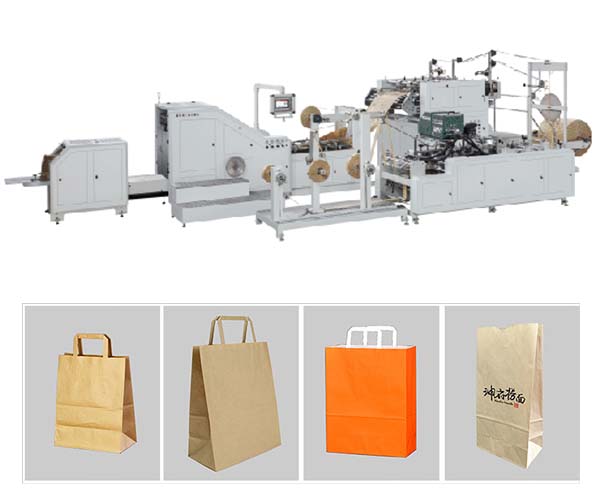
For operations that run V-bottom or satchel bottom bag configurations, quick changeover capability is especially valuable given the variety of bag sizes and paper weights these machines typically handle.
Operational Best Practices – Making Speed Sustainable
Even the best hardware and software won't deliver results without proper operational discipline. Here is a step-by-step framework for optimizing speed without sacrificing quality.
Optimize Machine Settings for Your Specific Material
Each paper type—different weights, recycled content, coatings—has its own optimal speed, tension, and temperature settings. Start with the manufacturer's recommendations, then fine-tune based on actual output quality.
-
Speed: Set speed incrementally. If you notice inconsistent bag size or sealing, reduce speed slightly to improve overall quality.
-
Tension: For 70–160 gsm kraft paper, start with 100–150 N tension and adjust based on feeding stability.
-
Temperature: Too high causes wrinkling and affects photoelectric tracking. Monitor seal strength at different speeds and adjust temperature accordingly—higher speeds typically require higher temperatures to maintain seal integrity within shorter contact times.
Use High-Quality Raw Materials
Using high-quality paper rolls with consistent thickness and smooth surfaces ensures smooth feeding, printing, and cutting processes. Variations in paper quality become magnified at higher speeds—a slight inconsistency that would be manageable at 100 bags/min can cause jams and defects at 200 bags/min.
Paper moisture should be kept in the 5–7% range; outside this window, you will chase curl and inconsistent folds.
Train Operators for High-Speed Conditions
High-speed machines demand higher technical skills from operators. Training should cover:
-
Identifying early warning signs of speed-related issues (vibration patterns, temperature drift, tension fluctuations)
-
Understanding how different paper types behave at speed and adjusting parameters accordingly
-
Performing safe, fast changeovers without rushing through critical steps
-
Using the HMI to monitor real-time production metrics and spot anomalies early
Implement Preventive Maintenance
Regular maintenance is non-negotiable for sustained high-speed operation. Key focus areas:
-
Cleaning: Dust and debris on sensors, guide rollers, and sealing units cause misalignment and defects
-
Lubrication: Proper lubrication of bearings, chains, and guide rails prevents wear that becomes critical at speed
-
Blade inspection: Dull blades cause uneven cuts and poor sealing quality; replace before they fail
-
Belt and chain tension: Loose chains slip; overtightened chains strain motors—both worse at speed
Monitor Production Metrics
Track actual output versus theoretical capacity. Effective throughput is not just speed—it's speed × uptime × yield. A machine running at 200 bags/min with 85% uptime and 95% yield produces 161 good bags/min. A machine running at 180 bags/min with 95% uptime and 98% yield produces 167 good bags/min. Slower but more stable often wins.
For lines that include slitting and rewinding equipment for preprocessing, remember that upstream quality directly affects downstream speed—rough edges from dull slitter blades create feeding problems that force the main bag machine to run slower.
Common Mistakes to Avoid
Even experienced operators make errors that undermine speed and quality. Here are the most frequent ones:
| Mistake | Why It Happens | How to Avoid |
|---|---|---|
| Increasing speed without adjusting temperature | Sealing time decreases at speed; temperature must increase to compensate | Monitor seal strength at each speed increment; adjust temperature proportionally |
| Ignoring tension drift | Tension fluctuations become more pronounced at speed | Use automatic tension control; check tension settings after each speed change |
| Skipping warm-up | Components need time to reach thermal equilibrium | Run at 50–60% speed for 10–15 minutes before full production |
| Overlooking sensor cleanliness | Dust on sensors causes misreads and jams | Clean photoelectric sensors daily; more frequently at higher speeds |
| Pushing through quality issues | "Just a few bad bags" mentality leads to massive waste | Stop and diagnose immediately; investigate root cause before resuming |
If you are unsure which speed and parameter combinations work best for your specific production mix, you can reach the technical support team to discuss tailored optimization recommendations for your equipment and materials.
From Guidelines to Action – Making It Work in Your Facility
Increasing paper bag machine speed without sacrificing quality is not about a single magic setting. It is a systematic approach combining hardware capability, control system intelligence, material quality, operator skill, and maintenance discipline.
Your action plan:
-
Audit your current operation – Measure actual speed, uptime, yield, and defect rates. Identify the biggest constraint.
-
Upgrade critical systems – If mechanical drive limits speed, consider servo upgrades. If tension control is the bottleneck, invest in closed-loop systems.
-
Optimize settings systematically – Make one change at a time. Measure results. Document what works.
-
Train your team – Ensure operators understand not just how to run faster, but why certain parameters matter at speed.
-
Monitor and adjust – Speed optimization is continuous. Track metrics. Learn from data. Refine your approach.
Once you have identified the speed and quality parameters that matter most for your production mix, comparing the specific capabilities of different machine configurations becomes the next logical step. You can review square-bottom paper bag machine designs for high-volume production or fully automatic handle paper bag machine solutions for retail packaging to see how different platforms handle speed and quality trade-offs.
Related Reading
-
Paper Bag Machine Maintenance: Daily, Weekly & Monthly Checklist
-
How to Operate a Paper Bag Making Machine Step by Step for Beginners
-
Square Bottom vs. V-Bottom: Which Bag Type Fits Your Business?
-
Understanding Full-Servo Technology in Paper Bag Manufacturing
-
Common Paper Bag Machine Problems and How to Fix Them
This article is part of LILIN's technical content library. No direct sales or pricing information is included. All technical discussions aim to help you make informed purchasing decisions.